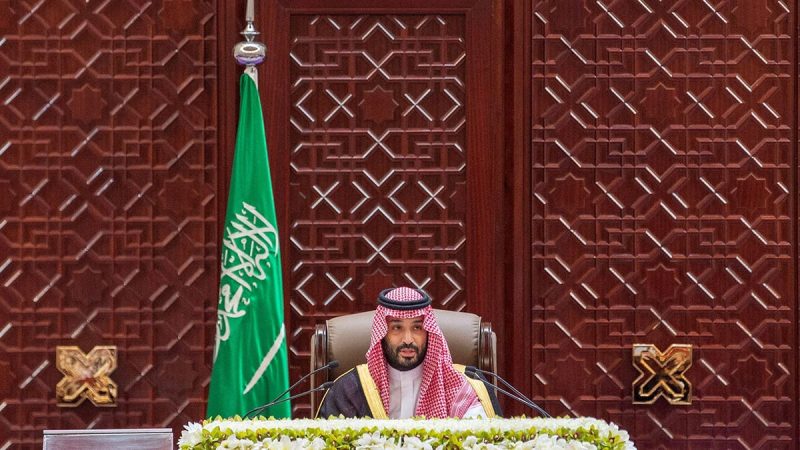
As Iran weakens, a power vacuum is emerging across the Middle East — and Saudi Arabia is moving to fill it by recalibrating relations with former rivals, hedging global partnerships and asserting a more independent foreign policy, according to several experts.
Javed Ali, former senior official at the National Security Council and professor at the University of Michigan, told Fox News Digital that ‘Since Iran’s 1979 revolution, both Saudi Arabia and Iran have vied for influence across the broader Muslim world. Mohammed bin Salman’s consolidation of power in the kingdom has also introduced a markedly different vision from that of his predecessors.’
Riyadh’s recent moves, from Yemen to Turkey, are fueling debate over whether Crown Prince Mohammed bin Salman’s expanding regional role still aligns with U.S. interests. As part of that recalibration, Bloomberg reported on Jan. 9 that Turkey is seeking entry into the Saudi–Pakistan mutual defense pact signed four months earlier, according to people familiar with the talks.
Michael Rubin, a senior fellow at the American Enterprise Institute, said Saudi Arabia’s current trajectory must be viewed through years of accumulated frustration with U.S. policy.
‘To be fair to MBS, previous U.S. administrations did not uphold their end of the bargain either,’ Rubin told Fox News Digital, pointing to repeated Houthi attacks on Saudi territory. ‘The Houthis launched hundreds of drones and rockets that the Obama administration ignored.’
Rubin said tensions deepened as Mohammed bin Salman pursued reforms long urged by U.S. policymakers, only to face sharp criticism from Washington. He cited the Biden administration’s decision to remove the Houthis’ terror designation.
‘By no objective measure should Secretary of State Antony Blinken have removed the terror designation from the Houthis,’ Rubin said, calling the move ‘pure spite directed at MBS and Donald Trump.’
Rubin said that decision marked a turning point. ‘MBS calculated that if the United States did not have his back, he would need to embrace a Plan B,’ he said, describing outreach to Russia and China as tactical signaling rather than ideological realignment.
Saudi geopolitical researcher Salman Al-Ansari rejects claims that Riyadh is drifting ideologically or embracing Islamist movements, framing Saudi policy as interest-driven.
‘Saudi Arabia does not base its foreign policy on ideological alignment, but on pragmatic considerations aimed at stability and development,’ Al-Ansari told Fox News Digital. He said outreach to Turkey reflects an effort to de-escalate rivalries. ‘The rapprochement with Turkey reflects this diplomatic approach, which seeks to transform the Middle East from a region of chronic conflict into one of greater stability.’
Al-Ansari said the shift has already delivered results. ‘This shift has given Riyadh increased flexibility in engaging regional powers, a change Ankara quickly recognized and that has translated into expanding economic cooperation.’
He rejected claims of alignment with the Muslim Brotherhood. ‘Saudi Arabia designated the group as a terrorist organization in 2014, and this position remains unchanged,’ he said.
Those competing interpretations of Saudi intent are now colliding most visibly in Yemen where the Saudi-Emirati alliance originally formed to counter Iran’s Houthi proxy. While both entered the war to roll back Iranian influence, their strategies diverged. Riyadh backs a unified Yemeni state under the internationally recognized government, arguing fragmentation strengthens Iran. The UAE has supported southern separatists, including the Southern Transitional Council, prioritizing control over ports and security corridors.
In the last few days, Saudi and Yemeni government forces have largely recaptured southern and eastern Yemen from the UAE-backed Southern Transitional Council (STC), and the STC’s leader reportedly fled to the UAE amid the group’s reported dissolution, highlighting a sharp rift involving Emirati support for separatists
Rubin called Yemen the clearest warning sign. ‘This is best seen in Yemen, where he has been supporting the Muslim Brotherhood faction militarily and attacking the more secular Southern Forces in a way that only empowers al Qaeda in the Arabian Peninsula and the Houthis,’ he said.
Al-Ansari countered that ‘differences with the UAE stem from its backing of separatist armed actors in Yemen, which complicates the political process, fragments the anti-Houthi front, and ultimately benefits the Iranian-backed Houthi militia.’
Rubin warned of long-term consequences. ‘By ‘blowback’ I mean the same Islamists MBS cultivates today will end up targeting Saudi Arabia in the future,’ he said.
With Iran weakened and regional power shifting, Washington now faces a central question: whether Saudi Arabia’s expanding role will reinforce U.S.-backed stability, or redefine the balance of power in ways that test the limits of the long-standing partnership.