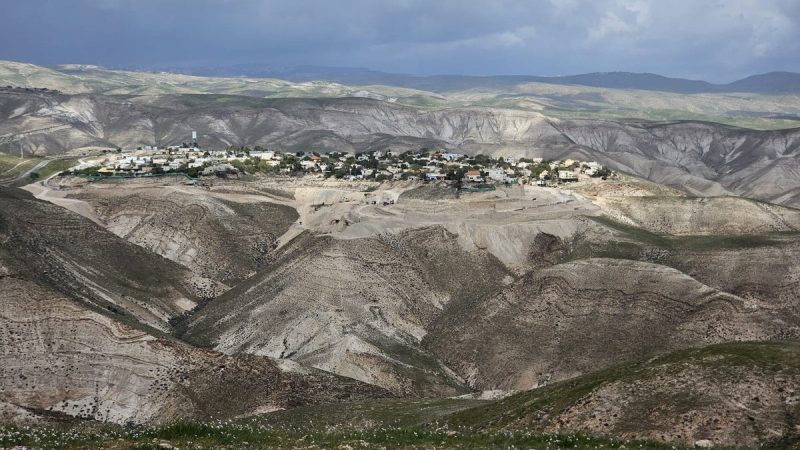
The Israel Defense Forces conducted approximately 80 brigade-level counterterrorism operations over the past year in the West Bank — known to Israelis as Judea and Samaria — neutralizing hundreds of terrorists and seizing more than 1,300 weapons, according to data released by the military.
The IDF said overall Palestinian terrorist activity in the area declined sharply in 2025, with incidents down 78% compared to the previous year. Attacks involving firearms dropped by 86%, the data showed.
Security remains essential in Israel’s ancient heartland, home to more than 500,000 Jews and up to 3 million Palestinians, and is at the center of intense political and diplomatic debate. Many Israeli officials argue that Jerusalem must assert sovereignty over the territory.
Under the 1993 Oslo Accords, brokered during the Clinton administration, the West Bank was divided into three areas: Area A, under full Palestinian control; Area B, under Palestinian civil authority and Israeli security control; and Area C, under full Israeli authority.
A 2020 plan by the Trump administration, known as ‘Peace to Prosperity,’ envisioned Israeli annexation of parts of Judea and Samaria but was shelved in favor of the Abraham Accords, which normalized Israel’s relations with four Arab countries. In July 2024, the Knesset plenum overwhelmingly rejected the establishment of a Palestinian state, and in July 2025, approved a declaration calling on the government to apply sovereignty in Judea and Samaria as well as the Jordan Valley, something Vice President JD Vance described as a ‘very stupid political stunt,’ when asked his thoughts on the vote.
On a visit to Israel, he said, ‘The West Bank is not going to be annexed by Israel… The policy of the Trump administration is that the West Bank will not be annexed by Israel. That will continue to be our policy. And if people want to take symbolic votes, they can do that, but we certainly weren’t happy about it.’
Why Israel Says It Can’t Give Up Judea and Samaria
Focusing on the national security significance of the area, Lt. Col. (Ret.) Jonathan Conricus, a former IDF international spokesperson and now a senior fellow at the Foundation for Defense of Democracies, told Fox News Digital that fundamental principles of warfare apply to the area.
‘High ground, or elevated terrain, remains critical and extremely important in defending a country, its people and its sovereignty,’ Conricus said. ‘I cannot identify any credible professional military assessment that would suggest it is wise for Israel to allow a hostile entity to dominate high terrain that controls, by line of sight and fire, most of modern Israel west of the 1949 armistice line, where 80% of Israel’s GDP and 70% of its population reside.’
Conricus said that no Israeli government could relinquish military control over the area without endangering the most basic security of the State of Israel.
He emphasized that the area defines Israel’s eastern border and noted that, while Israel currently maintains strategic peace with Jordan, the kingdom remains unstable and vulnerable to both internal and external pressures.
‘It could be jihadist elements, the Muslim Brotherhood, Hamas or the Iranian regime,’ he said. ‘Israel has to have an eastern border that is a natural barrier. The Jordan River is a natural barrier that limits the movement of troops, tanks and vehicles, and provides a border that is defensible,’ he said.
Dan Diker, president of the Jerusalem Center for Security and Foreign Affairs, pointed to the concept of defensible borders that emerged after the 1967 Six-Day War.
‘As a result, Israel gained a major defensive position and strategic depth it had never previously possessed,’ Diker said, noting that Israel had been only nine miles wide at its narrowest point in the north.
After the Hamas-led Oct. 7, 2023, massacre, Diker said its strategic importance has increased amid concerns that a similar large-scale attack could occur there, given the widespread flow of weapons.
‘Although we control between 60% and 75% of the region, Iran has been penetrating the Jordanian border,’ he said, adding that Hamas incitement has energized jihadist networks.
Biblical, Historical and National Identity
Yishai Fleisher, international spokesman for Hebron — the cradle of Jewish civilization located in Judea — told Fox News Digital that the vast majority of events described in the Bible took place in Judea and Samaria.
Hebron, he said, is home to the Tomb of the Patriarchs and Matriarchs, while Jerusalem is where the two Jewish Temples stood and where King David reigned. In Bet El, the Biblical account of Jacob’s dream of the ladder took place.
‘The reason we have national aspirations in the Land of Israel is because of our history,’ Fleisher said. He also cited an initiative to rename Route 60 — which runs through many Biblical cities — the ‘Biblical Highway.’
Who Are the Hilltop Youth — and Why Israel Sees Them as a Problem
Earlier this month, IDF troops were dispatched to the Shavei Shomron Junction following reports that dozens of masked Israeli suspects had vandalized property in the area. Several Palestinian vehicles were torched, and two Palestinians were injured. A day later, IDF troops were dispatched to the area of Jalud following reports that Israeli civilians had vandalized a local school. In a separate incident in the Bizzariya area, several Palestinian vehicles were set on fire and property was damaged.
In 2025, the IDF recorded an increase of approximately 27% in anti-Palestinian crimes.
Governor of Binyamin and Chairman of the Yesha Council Yisrael Ganz told Fox News Digital that Judea and Samaria has been in a state of war since Oct. 7. Over the past year, he said, citing Shin Bet data, there were more than 4,000 attempted attacks against Israelis.
Ganz cited former Shin Bet head Yoram Cohen, who said only 1.5% of Shin Bet cases involve Jews, while roughly 80% focus on Arab terrorism.
‘Yes, there are incidents of violence, but the number of Jews who attack Arabs is negligible,’ Ganz said, condemning extremist youth as a small and unrepresentative minority.
Ganz argued that the absence of Israeli sovereignty creates a legal gray zone that enables extremism.
‘When there is governance, security and economic opportunity, there is no room for anarchy or violence,’ he said, envisioning Judea and Samaria as ‘the Israeli Tuscany.’
Is the Two-State Solution Still Viable — or Just Diplomatic Habit?
Former Israeli Ambassador to the United States Michael Oren told Fox News Digital that the two-state solution was never viable but rather a diplomatic reflex.
‘The Palestinians hold the world record for a people who have been offered a two-state solution and have rejected it,’ Oren said. ‘They rejected it in 1937, the British offer in 1947, the American-Israeli offer in 2001, and the subsequent offer in 2008.’
According to polls, Oren said, most Palestinians oppose a two-state solution and support the Oct. 7 attacks.
‘Rather, the two-state solution is viewed as an interim stage toward a one-state solution,’ he said, a phrase often used as a euphemism for the eventual destruction of Israel through demographic change.
While acknowledging Palestinian self-rule in Areas A and B, Oren said a fully sovereign Palestinian state is impossible.
‘It could not have control over its borders, nor control over strategic affairs, such as entering a defense pact with Iran. It will never be a classic sovereign state, but it could be more than what they have today,’ he said.
While a two-state solution once seemed inevitable, Dan Shapiro — who served as U.S. ambassador to Israel under President Barack Obama and as deputy assistant secretary of Defense for the Middle East under President Joe Biden — told Fox News Digital that it has not been viable for many years and may now be harder to envision than ever, particularly in the aftermath of Oct. 7.
Still, Shapiro said, the framework remains a fixture of Middle East diplomacy due to the lack of viable alternatives for resolving the conflict between two peoples living in one land, each with legitimate claims to a homeland.
‘President Trump includes a credible pathway to a Palestinian state in his 20-point plan to stabilize Gaza and remove Hamas from power. Presidents Biden and Trump have both viewed progress toward a Palestinian state as part of the formula to achieve Saudi normalization with Israel,’ Shapiro said.
‘None of this means it can happen soon, or perhaps at all. If it ever does, it will take longer and look different from earlier efforts. It is not a copy-and-paste of ideas from the Oslo era. But that credible pathway to a Palestinian state — one that would live peacefully alongside a secure Israel — difficult as it is, remains relevant,’ he added.
Shapiro noted that even Israel’s current government — the most right-wing in the country’s history and one that includes multiple proponents of annexation — has stopped short of applying sovereignty across the West Bank, a sign, he said, that the political and diplomatic costs remain too high.
‘President Trump has announced that it will not happen because he promised Arab states — the same ones he does business with and relies on to help stabilize Gaza — that it will not happen, and Netanyahu will not oppose him on it,’ Shapiro said.
Shapiro said that preserving the possibility of establishing a Palestinian state on some portion of the territory — even if it appears distant and would require major changes in Palestinian leadership and society — has remained relevant, even under Israeli governments that profess to oppose any two-state outcome.